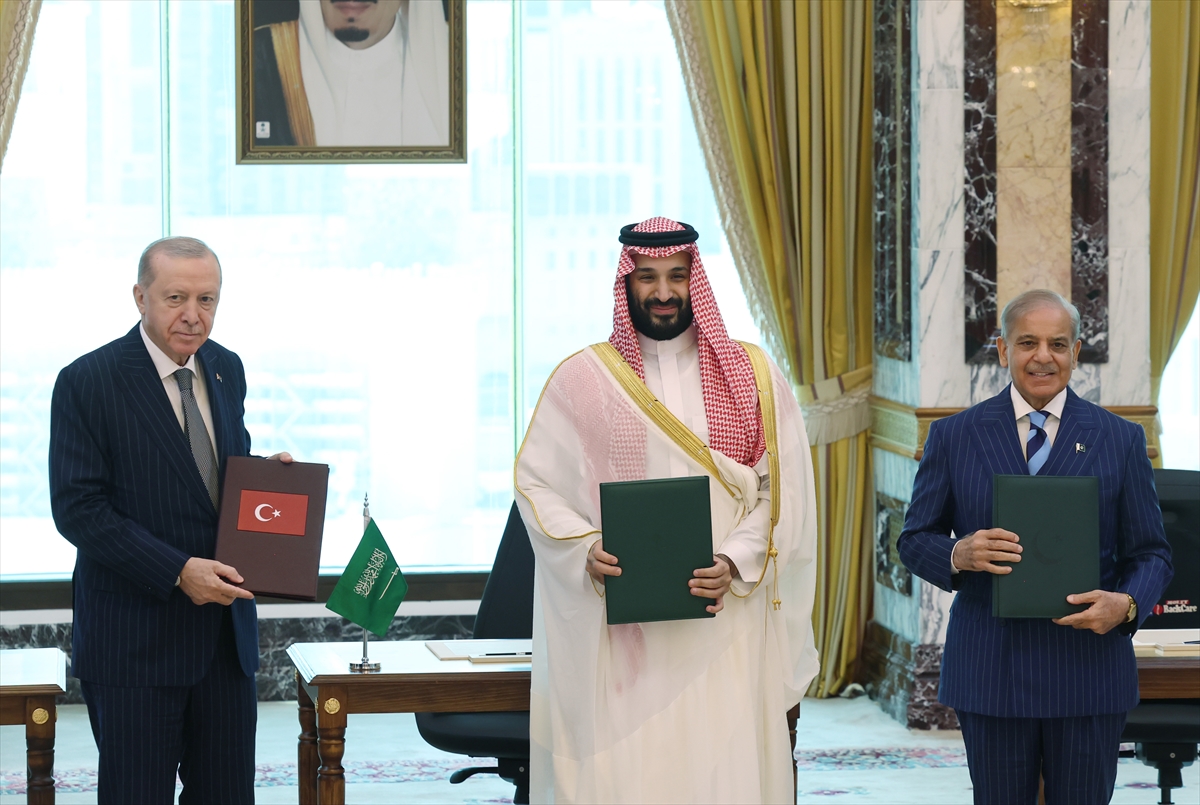
Riyadh and Ankara probably won’t defend Pakistan against India, but what they will do to equip Islamabad in future conflicts matters more — money, weapons, and the logistics to fight longer.
A week after the signing of the Joint Defence Agreement in Mecca, Saudi Arabia, between the three regional powers, Turkey laid out the mechanisms of the defence pact with Islamabad and Riyadh.
The Turkish defence ministry said the pact aims to hold joint military exercises and deepen defence industry cooperation through joint development and production, technology cooperation, and sustainable maintenance and logistics support.
The ministry statement also added that the regional powers would prioritize unmanned and autonomous systems, electronic warfare, and artificial intelligence capabilities.
Table of Contents
- Defence Pact or Islamic NATO?
- What Saudi Arabia Will Do
- Why Turkey Is The Problem
- A Shorter Clock for India
- The Indus Treaty Question
- Takeaway for New Delhi
Defence Pact or Islamic NATO?
While the Mecca agreement provides mutual support, it does not specify what each country would be obligated to do in the event of a potential conflict.
Aishwaria Sonavane, a research analyst at the Takshashila Institution who specializes in Pakistan and Indo-Pacific issues, said that while many in India are calling this agreement an Islamic NATO, she urges caution against the rhetoric.
She said that NATO’s Article 5 does not automatically commit identical forces from every member.
What makes NATO credible is the institutional apparatus behind the promise, including integrated command, established procedures, and decades of interoperability.
The research analyst said that none of that exists in the Mecca Agreement as of now. Overreaction from India would be considered a mistake.
“The primary drivers of this pact are rooted in the West Asian security framework,” Sonavane said.
The security framework was built around Israel, the fallout from the Iran conflict, Houthi threats to Red Sea shipping, drone and missile risks to Gulf infrastructure, and a shared desire for strategic autonomy from Western powers.
What Saudi Arabia Will Do
While the announcement of the agreement has elevated Islamabad’s diplomatic standing, Sonavane added that Pakistan lacks the influence to compel Saudi Arabia to serve as a shield against India during conflicts.
“Saudi Arabia is Pakistan’s patron, not the other way around,” the research analyst said.
As one of New Delhi’s largest energy suppliers and a significant investor in the Indian economy, Riyadh did not openly support Islamabad during its earlier conflicts with India.
Saudi Arabia exercised a balanced approach towards India’s counterattacks following the Pulwama attacks and last year’s Operation Sindoor.
Saudi Arabia and Pakistan signed a mutual defence agreement last year.
Despite the agreement, Riyadh didn’t come out overtly in Islamabad’s support during its armed conflicts with the Taliban administration in Afghanistan.
Pakistan also declined to join Riyadh against the Houthis in 2015.
Why Turkey Is The Problem
In the Mecca agreement, Sonavane said Turkey is “a bigger source of friction for New Delhi.”
In recent years, Ankara has consistently taken political decisions that are critical of India, such as the Kashmir issue.
It is now Pakistan’s second-largest defence supplier after China, which accounts for roughly 80 percent of Pakistan’s military equipment.
During last year’s Operation Sindoor, Islamabad deployed Turkish defence systems acquired through existing defence ties.
Sonavane, however, cautioned that selling defence hardware to Pakistan does not mean Turkey is prepared to enter an armed conflict against India on Islamabad’s behalf.
A Shorter Clock for India
While Sonavane reads Saudi patronage and its historical stance during past armed conflicts as a restraint on Islamabad’s military adventurism, Indian Army Brigadier Anil Raman (Retired), a research fellow at the Takshashila Institution and a former REDFOR analyst, reads the same dependency as an operational concern.
He said the agreement immediately facilitates the flow of funds from Riyadh to Islamabad and of weapons and technology from Turkey to Pakistan.
According to the former REDFOR analyst, as a nation with severe debt, Pakistan benefits heavily from Saudi funds.
The arithmetic is stark. Saudi Arabia’s defence budget stands at $63.9 billion, compared with Pakistan’s $9.1 billion, according to the Global Firepower Index.
A marginal share of Saudi spending could materially change what Islamabad can buy, stockpile, and maintain.
“We should not be waiting till the war breaks out,” Raman said. “The moment the agreement is signed, the Pakistani military strength will improve tremendously.”
The brigadier said India would find it significantly harder to achieve its strategic objectives when responding to future Pakistani provocations.
“Earlier it was only the US that was trying to stop the conflict,” Raman said. “Now you will have Saudi Arabia trying to stop the conflict.”
He said that along with its trade relationship with India and being a military treaty partner to Pakistan, Riyadh can pressurize New Delhi and Islamabad to de-escalate if future armed conflict arises between the two nuclear-powered nations.
It will certainly not be in support of Islamabad’s position, but rather out of an interest in preventing a South Asian conflict from widening.
India needs time to prepare and achieve its objectives before a ceasefire arrives in the face of Pakistani provocation. Operation Sindoor ran for four days.
A second influential voice calling for a ceasefire means less time to accomplish what an operation was launched to accomplish.
A conflict that ends early, before India has achieved its objectives in response to Pakistani provocation, is a loss for India.
“We will not have enough time to achieve the kind of victory we want,” the brigadier said.
The pact’s most immediate effect on India may therefore be temporal rather than territorial.
New Delhi will have a shorter window in which to decide what can be achieved before outside pressure becomes difficult to resist.
The Indus Treaty Question
Since last year’s Pahalgam attack, India has placed the Indus Water Treaty in abeyance.
Last month, a senior Indian government official said that the treaty will not function in its present form until Pakistan ends its support for cross-border terrorism.
India is currently commissioning roughly 5,300 MW of hydropower on the western rivers.
Pakistan has since called for any attempt at water diversion by New Delhi to be considered an act of war.
In Pakistan’s Independence Day (August 14) speech, Prime Minister Shehbaz Sharif reiterated this position and said that “every single drop of Pakistani water is our red line.”
The Indus Basin is a critical lifeline for Pakistan.
It fulfills around 94 percent of the country’s agricultural needs, according to the World Bank.
It represents around 23 percent of its GDP.
All 21 of Pakistan’s hydroelectric plants, which generate one-fifth of the country’s electricity, are in the Indus basin, according to the Centre for Strategic and International Studies.
Sonavane noted that Pakistan attracts deeper sympathy for the Indus water issue than it does for the Kashmir issue.
She was careful to add, however, that the technicalities surrounding the water issue fall to climate and water specialists rather than to her.
She said that even with Pakistan’s uplifted diplomatic standing since it was chosen as mediator for the Washington-Tehran armed conflict, it hasn’t been successful in internationalizing the issue of the Indus Water Treaty and Kashmir.
India’s diplomatic weight in the global forum has so far prevented it.
While Brigadier Raman also agrees with the assessment of Pakistan’s uplifted diplomatic status in the international community, he declined to attribute any future conflicts with Pakistan to any single trigger.
Neither expert would link the Mecca agreement directly to the water dispute.
For now, the Indus question appears to be a diplomatic contest rather than a military flashpoint between India and Pakistan.
Takeaway for New Delhi
The experts have said the defence agreement was not built against India.
Raman said it was created due to Riyadh’s doubts about Washington’s security guarantees, Turkish anxiety regarding Israel, and Pakistan’s efforts to improve its financial situation and diplomatic standing on the global stage.
He added that the military alliance is a strategic diversification that began long before the Middle East crisis.
India can neither deter an arrangement it did not provoke nor negotiate away one it was never a party to.
While Turkey and Saudi Arabia might not get involved militarily against India in support of Pakistan, the real danger will be a better-equipped Islamabad.
Better access to high-tech weapons and adequate funding will give the Pakistani army greater endurance in future conflicts with India.
Furthermore, it will be a shorter clock for New Delhi to plan and achieve its strategic military objectives in response to future Pakistani provocations along its borders.


Well articulated and insightful…worth to read
LikeLiked by 1 person
Informative and insightful
LikeLike