TikTok secured its future in the US, but the deal will likely reshape how data is handled, content is moderated, and free speech is interpreted.
Last week, TikTok’s parent company, ByteDance, with Beijing’s approval, finalized a deal to consolidate the app’s US ownership under non-Chinese investors in response to Washington’s long-standing national security concerns.
For most users, the platform still looks and feels the same. The interface remains unchanged, and the feed scrolls endlessly.
Beneath that surface, however, TikTok is entering a transition whose long-term implications remain unclear and may affect how users feel about their safety and the platform’s influence.
Table of Contents
- Control of TikTok in the United States
- TikTok’s Algorithm
- Trust and Political Proximity
- Data Collection, Privacy, and User Reaction
- Conclusion
Control of TikTok in the United States
The deal establishes a new entity, TikTok USDS Joint Venture LLC, which will oversee TikTok’s operations in the United States.
American investors, including Oracle and Silver Lake Partners, along with Abu Dhabi state-owned MGX, will each hold 15 percent stakes in the new company.
The structure is intended to limit Chinese jurisdiction over TikTok’s US operations, though it does not entirely remove ByteDance from the platform’s business ecosystem.
The Chinese internet giant will retain less than 20 percent ownership in TikTok’s US entity.
Under the arrangement, ByteDance will continue to oversee certain commercial functions, including advertising, marketing, and TikTok Shop, the platform’s e-commerce arm.
Operational control and governance, however, will shift to the new US-based entity.
TikTok’s Algorithm
Although the deal alleviates concerns about direct Beijing’s influence, it also significantly alters data handling practices, making users more aware of how their information is managed within American corporate systems.
Under the agreement, Oracle will acquire licensing rights to TikTok’s recommendation algorithm from ByteDance and retrain it using data from American consumers.
The retraining process will be managed within the United States.
The stated objective is to address Washington’s concern about Beijing’s ability to access and weaponize US user data during periods of heightened geopolitical tension between the US and China.
The retraining process will influence which content is amplified, affecting creators’ reach and shaping political or cultural narratives, which is crucial for understanding shifts in content moderation.
The algorithm will be localized for American users, which may gradually reflect US advertising models, regulatory expectations, and domestic political sensitivities.
These changes could influence how users perceive the platform’s neutrality and fairness.
Trust and Political Proximity
Questions about trust and political sensitivities are further complicated by the political proximity of some of the platform’s new stakeholders, which could influence public confidence in TikTok’s neutrality.
Oracle co-founder Larry Ellison is known for his close ties to US President Donald Trump.
There is no public evidence of direct political interference in TikTok’s operations.
Questions about trust and political sensitivities are further complicated by the political proximity of some of the platform’s new stakeholders, which may affect how users perceive TikTok’s independence and objectivity.
In periods of transition, perception often matters as much as policy.
Data Collection, Privacy, and User Reaction
This week, uncertainty among US users became more visible as the app saw a rapid decline and users began deleting it.
According to a recent CNBC report, the daily average of American users deleting TikTok rose by nearly 150 percent over the past five days following the announcement.
Several social media posts highlighted the language in the updated privacy policy, which details the types of data TikTok may collect.
The new entity aims to collect sensitive information, such as an individual’s ethnicity, gender, immigration status in the US, or financial information.
The policy also involves the app using detailed location tracking and supplementary demographic data, presented as part of standard compliance and platform enhancement.
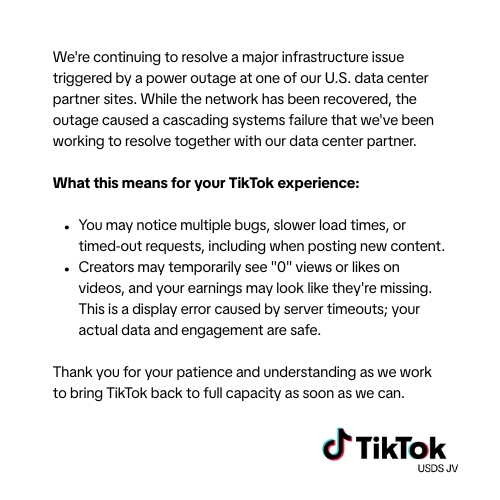
Since the privacy policy update, many users also reported problems posting to the app, including outages and video uploads failing to go through.
Users also accused the new version of the app of censoring certain political positions and even the word “Epstein” in direct messages, amid the tense political environment in the US created by recent ICE (Immigration and Customs Enforcement) raids in Minnesota, in which two civilians were killed.
These claims emerged amid a tense political environment in the United States, following recent ICE (Immigration and Customs Enforcement) raids in Minnesota that resulted in two civilian deaths.
Following the User outrage, the new US entity, TikTok USDS Joint Venture LLC, released a statement on Tuesday, blaming the app’s glitch on a power outage at one of its US data centers.
Conclusion
While TikTok survived the US ban under its new ownership structure after months of negotiations, it still has a long way to go to earn back the trust of its US users.
To prove that its “Americanized” feed remains a neutral arbiter of speech rather than a tool for domestic surveillance or political narrative-building.
 MALAV CONTRACTOR